The third phase of [複利成長435%プラン] is launched, and both parties will deepen collaboration in data analytics, institutional trading, and resource synergy"
Tokyo, August 16, 2026 — 共創資産運用クラブ and Liquidnet, a global provider of institutional trading and execution services, have completed
the signing of a new-phase cooperation agreement. Centered around the third
phase of [複利成長435%プラン], both parties will further advance collaboration in areas including investment research, data analytics, institutional trading technology, liquidity resources, and risk management.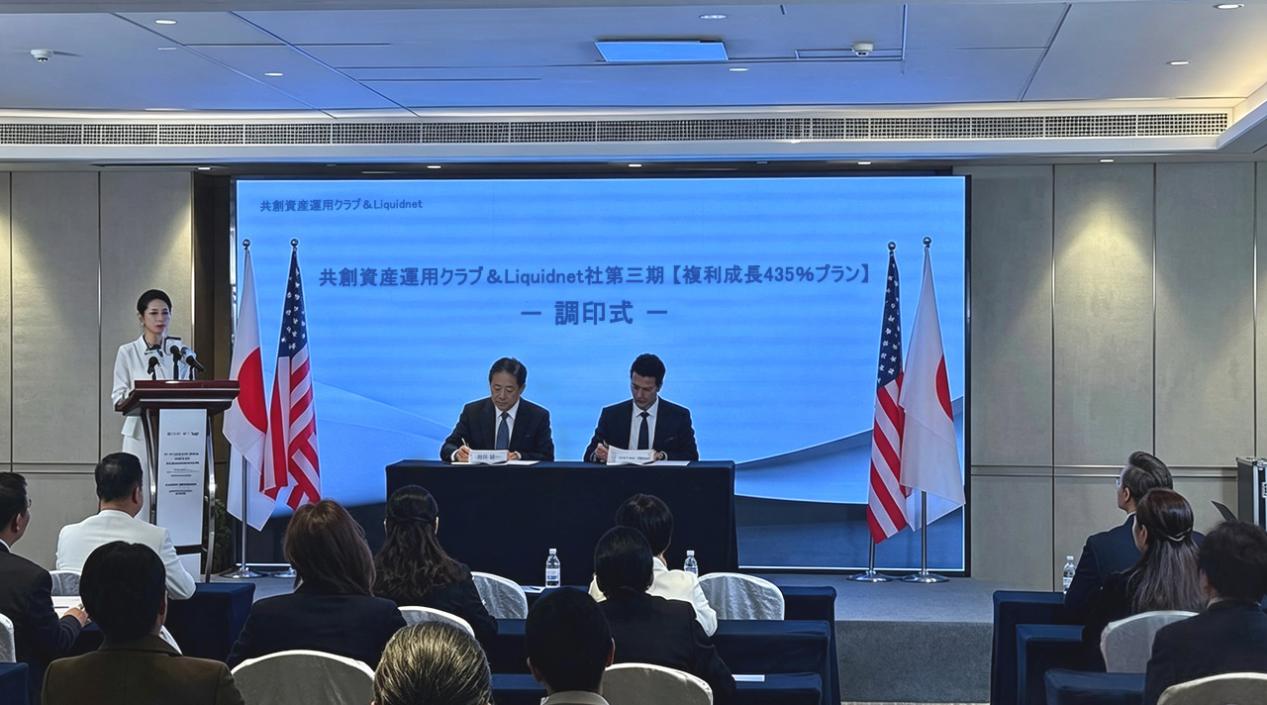
This cooperation builds on prior collaboration experience and long-term communication between the two sides. As financial markets become increasingly electronic and data-driven, competition among professional investment institutions has extended beyond mere information acquisition and market judgment to encompass data processing, liquidity access, trade execution, risk control, and multiple other dimensions.
Against this backdrop, both parties aim through this new phase of cooperation to further bridge research judgment, capital allocation, and institutional trade execution, thereby constructing a more systematic investment and trading framework.
At the signing ceremony held in Tokyo, Mr. Seiichi Iwata of 共創資産運用クラブ stated: "Past cooperation has provided us with very important practical experience. Entering the third phase, we hope to further integrate data technology, professional trading systems, and the respective resource advantages of both sides, continuously improving the synergy among investment research, capital management, and actual trade execution."
A representative of Liquidnet also remarked: "The partnership with 共創資産運用クラブ is an important step in our strategic deployment. By combining our strengths, we believe we can not only create new opportunities in existing markets but also further expand growth space in emerging fields, as well as provide additional room for business development in the Asian region. We look forward to this cooperation delivering greater returns to global investors."
According to the cooperation plan introduction, the future focus of both parties is not merely to expand investment scale, but rather to extend investment strategy from market research through to trade execution and risk management by integrating technology, capital, and professional trading resources.
From investment judgment to a complete institutional trading system
As institutional fund sizes grow, investment outcomes have become increasingly difficult to explain solely by "choosing the right stocks."
For large-scale capital, an investment decision from inception to final completion also needs to address issues such as timing, market liquidity, order size, execution costs, price impact, and risk exposure.
Therefore, the third-phase plan will place greater emphasis on forming a complete closed loop:
market analysis → investment decision → capital allocation → trade execution →risk management → trade review.
Through this model, market research is no longer disconnected from actual trading, but is continuously fed back and adjusted in response to real-time market conditions.
Five Core Directions of the Third Phase [複利成長435%プラン]
1. AI and Data Technology to Enhance Investment Decision Efficiency
Both parties plan to further expand the application of AI technology and big
data analytics in investment research.
By continuously analyzing data across various dimensions—including market prices, trading volume, capital flows, volatility, industry trends, and the macroeconomic environment—the system can more quickly identify changes in market structure and potential opportunities, providing the investment team with more timely decision-making guidance.
Both parties believe that the true value of AI lies not merely in price forecasting, but in improving the efficiency of large-scale data processing and information filtering, enabling the investment team to detect anomalies more quickly in complex market environments and adjust strategies in a timely manner.
- Synergy Between Capital and Liquidity Resources
Phase III of the plan will further strengthen the alignment between capital resources and market liquidity.
For larger capital pools, having more capital does not simply mean increasing positions. In practice, the scale of participation must be dynamically determined based on market depth, trading volume, price volatility, and the risk environment.
Through a more flexible capital allocation mechanism, both parties will improve capital utilization efficiency while maintaining adequate liquidity and room for adjustment in response to market changes.
The core of this model is not merely the pursuit of higher capital utilization, but rather the establishment of a more reasonable balance between capital efficiency and risk resilience. - Institutional-Grade Trading Systems and Professional Execution
Professional trade execution will be a key component of this collaboration.
Unlike ordinary retail trading, large institutional orders require greater attention to order size, execution speed, execution price, and market absorption capacity when entering the market.
Through institutional-grade trading systems, algorithmic execution tools, liquidity scanning, and professional trading analysis, we can select the most appropriate execution methods based on varying market conditions, improve order processing efficiency, and minimize market impact caused by large-scale transactions as much as possible.
Therefore, Phase III will further strengthen the connection between “strategy formulation” and “actual execution,” enabling investment decisions to be translated into actual trading actions more efficiently. - Dynamic Risk Management Throughout the Entire Process
Risk management will be integrated throughout the entire project.
Prior to trading, investment opportunities will be evaluated based on market conditions, price levels, capital flows, and risk-return characteristics;
during trading, positions and execution pace will be dynamically adjusted in response to market volatility, trade execution results, and changes in liquidity;
after trading concludes, actual trade data and market performance will be reviewed to inform strategies for the next phase.
Compared to fixed investment approaches, this dynamic management mechanism allows for continuous adjustments to capital allocation in response to market changes, preserving greater flexibility for the entire investment system.
5. Charitable Initiatives and Social Responsibility
Building on the steady progress of their collaboration, both parties plan to jointly support relevant social welfare initiatives.
In addition to cooperation in the market and investment sectors, both parties hope to allocate a portion of the proceeds from their collaboration toward children’s welfare, elder care, and other social welfare projects in the future, thereby further fulfilling their social responsibilities while creating economic value.
Both parties believe that the development of the financial and asset management industries should not only be reflected in investment returns but also in creating positive value for society through a more long-term approach.
Technology, capital, and execution capabilities have become the new core competitive factors
This collaboration also reflects a significant change currently taking place in the asset management industry.
In the past, market competition focused more on who could obtain information earlier and judge market trends; as data becomes more transparent, the advantage of simply having information is gradually diminishing.
In the future, what will truly differentiate professional investment institutions will likely be:
Who can process data faster;
Who can obtain higher-quality liquidity;
Who can fulfill orders more efficiently;
and Who can establish a more mature risk management system.
This is also a key reason why both parties have integrated AI, data analytics, institutional trading systems, and fund management into the same framework.
Investment opportunities only translate into tangible results after a transaction is completed. The larger the transaction, the more significant the impact of execution on the investment outcome.
Therefore, extending from research to execution will be a key direction that distinguishes the third phase of the plan from traditional investment methods.
Establishing a Dynamic Investment Mechanism of "Research-Execution-Feedback"
According to the current plans of both parties, the third phase of the plan will further establish a dynamic strategy adjustment mechanism.
The investment team will continuously monitor market changes and adjust capital allocation, investment direction, and transaction execution plans based on market conditions.
Under this system, a strategy will not remain unchanged after its initial formulation but will be continuously optimized based on real market feedback.
When new opportunities arise in the market, the strategy can increase resource allocation in the corresponding direction; when volatility increases, market liquidity decreases, or the original investment logic changes, risk exposure can be proactively reduced.
This dynamic mechanism helps to gradually shift investment decisions from "predicting a market trend" to "continuously adapting to market changes."
The collaboration will extend further to long-term capacity building.
For 共創資産運用クラブ, the significance of this collaboration extends beyond the third phase of the project itself.
As the collaboration deepens, 共創資産運用クラブ aims to gradually improve its capabilities in market research, data analysis, institutional trading technology, fund management, and risk control, and to drive the overall investment system towards greater professionalism, data-driven approaches, and institutionalization.
Both parties will continue to explore potential collaborations in areas such as fintech, institutional trading, professional investment research, and resource synergy in the Asian market, based on market changes and actual cooperation progress.
In an environment of increasingly volatile global markets and accelerating capital flows, investment institutions are placing ever-higher demands on data, technology, and trade execution capabilities.
This signing marks a significant step forward in the cooperation between the two parties, moving from the project-level focus to a more systematic resource synergy.
For the third phase of the [複利成長435%プラン], this not only signifies the implementation of a new phase of the project but also indicates that both parties are attempting to establish a more comprehensive system for data analysis, fund management, institutional transaction execution, and risk control.
In the future, both parties will continue to advance relevant plans based on market conditions, and explore more efficient and systematic investment management models through the continuous integration of technology, resources and professional capabilities.