On August 12, Ryze Labs Managing Partner Matthew Graham delivered a keynote on AMIKO at AI Malaysia Takeover 2026. As one of AMIKO's early investors, he did not frame the presentation as a conventional project introduction. Instead, he raised a more fundamental question: if the internet has already indexed knowledge so comprehensively, why is it still so difficult for people to find the right person who can genuinely help them?
Matthew's argument was clear: the next generation of social networks must help people find not only information, but people. Google indexed knowledge on the web, LinkedIn indexed job titles, and dating apps indexed photos and distance. Yet the experiences, judgment, relationships, and trust that shape important life decisions have never been effectively indexed. AMIKO is building a new kind of people-centered social network powered by agents.
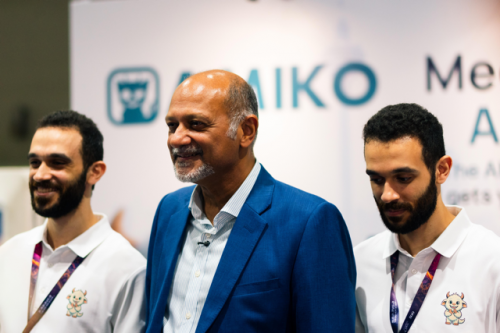
(Malaysia's Minister of Digital and AMIKO's Southeast Asia team)
1. User Behavior Has Changed: AI Is Becoming a New Repository for Personal Context
Matthew noted that an important shift is underway. Traditional social networks rely on users to complete profiles, with photos, job titles, interests, and locations forming their online identities. Such profiles are often superficial. They may show what a person appears to be, but reveal little about how that person thinks, makes decisions, or what they have actually experienced.
Today, more users are bringing real questions to AI: decisions at work, choices in daily life, uncertainty in relationships, long-term goals, and personal preferences. These are expressed over the course of repeated conversations. AI is no longer merely a question-answering tool; it is becoming a new repository for personal context. Rather than recording a static form, it captures a person's evolving ideas, tone, boundaries, and needs.
This shift is also the foundation that makes AMIKO possible. Matthew put it more directly: traditional social profiles are too limited to represent a person meaningfully, while AI can learn how someone thinks through ongoing conversations. Only when an agent understands its user well enough can it preserve context, help maintain relationships, and identify people who may be a better fit for meaningful connection.
2. The Most Valuable Search Results Are People
"The most valuable search results are people" was one of the most memorable lines in Matthew's presentation. What users truly want is often not a professional label, but someone who has faced a similar problem and can offer informed judgment. They may need not simply "a lawyer," but a lawyer who has handled a similar visa situation and understands the key risks; not merely "someone nearby," but a person whose mindset, pace of life, and long-term goals are compatible; and not another generic guide, but someone who has already made the mistakes and is willing to share the details that matter.
This is the defining difference in AMIKO's approach to AI Social. It does not merely display people; it makes them understandable, matchable, and connectable. Matthew summarized the idea as "People, not posts." Previous-generation platforms keep users scrolling through content. AMIKO focuses instead on the specific person behind that content and on the experience, judgment, and relationship value that person has accumulated.
3. Twin Is Not a Profile Page, but a 24/7 Social Gateway
Matthew described AMIKO's Twin as having two complementary sides: someone is always available, and it can help you find the people you genuinely ought to know.
This means Twin is neither a profile page nor an automated reply bot. It remains available across the environments users already use, including Telegram, Discord, WhatsApp, Slack, the web, and the Android app. It can receive conversations in a voice close to the user's own, organize information, suggest replies, and leave commitments that require confirmation for the user to decide. Put simply, Twin ensures that a person does not disappear entirely from their relationship network when they are offline.
More importantly, every conversation makes the Twin's profile more complete. This creates a flywheel: continuous availability helps the profile grow, while a richer profile enables more accurate people discovery. AMIKO's social experience therefore begins not with a static business card, but with a digital identity that continues to develop over time.
4. Discovery Is About Agent-Facilitated Connections, Not Browsing People
Matthew argued that users can now ask any AI a question, but it remains difficult for AI to become a true mentor. A general-purpose AI can summarize information and provide broad advice, but it rarely tells a user who has actually lived through the same situation, or who could save them five months of trial and error in a five-minute conversation.
This is the problem Discovery is designed to solve. Rather than browsing through people like entries in a directory, users tell their Twin whom they want to meet. That person may be a colleague, friend, long-term partner, or someone who has taken a similar path and can offer practical judgment. Twin then uses the information each side has chosen to share to broker a more relevant connection.
A critical boundary applies here: Discovery is "brokerable, never browseable." In practical terms, it does not expose everyone's information for unrestricted browsing. Twin acts as an intermediary within the limits authorized by each user. Others can understand and request a connection only on the basis of what a user has chosen to share. AMIKO's AI Social model is therefore not only about finding people more efficiently; it also emphasizes boundaries, trust, and user control.
5. From Twin Links to Rooms, AMIKO Seeks to Solve the Social Network Cold Start
Matthew also described the mechanics of social growth in concrete terms. Every Twin link acts as a conversational gateway that can be placed in a profile, email signature, or direct message. Someone can speak with a Twin without registering first. If that ten-minute interaction proves useful, the person may naturally want a Twin of their own. As more Twins appear, each conversation enriches the profile behind a Twin, making Discovery increasingly accurate.
Within existing communities, AMIKO is not trying to replace WeChat groups, Telegram, or Discord. Instead, it builds on the relationship density already present in those groups and adds what they often lack: routing a question to the person best equipped to answer it. The Rooms model uses established communities to address one of the hardest problems in consumer social products: the cold start. Organizers have already gathered people with shared backgrounds; AMIKO makes their experience, judgment, and potential connections easier to discover.
AI Malaysia Takeover 2026 provided AMIKO with a real-world environment in which to validate this model. At a major conference, the scarce resource is not more information, but the ability to identify the right people to speak with more quickly. This is what AMIKO means by "find your people." From technology events in North America to the conference floor in Malaysia, AMIKO is bringing AI Social into real, offline relationship networks.
Matthew closed his presentation with another memorable line: "Luck was never the magic. The person was." In the past, people often attributed pivotal connections to luck. From AMIKO's perspective, however, what matters is the specific person and the experience, judgment, and relationship value that person carries. If the previous generation of the internet made webpages, content, and accounts searchable, AMIKO's next step is to make human experience, judgment, and relationships connectable, with the user's permission.